How to Tell a Second-Skin Legging From a Compression Legging in 30 Seconds
Quick Answer: Second-skin leggings are built to disappear - high elastane, low modulus fabric that stretches easily in every direction and recovers gently. Compression leggings are built to push back - denser knit, higher recovery force, often panelled. Three tests tell them apart in under a minute: stretch the waistband one-handed and feel the resistance, hold the fabric to the light and check opacity change under stretch, and look at whether the seams are flat-locked and curved or straight and structural.
Both were described as buttery. Both cost about the same.
One vanished on the body and the other announced itself for four hours.

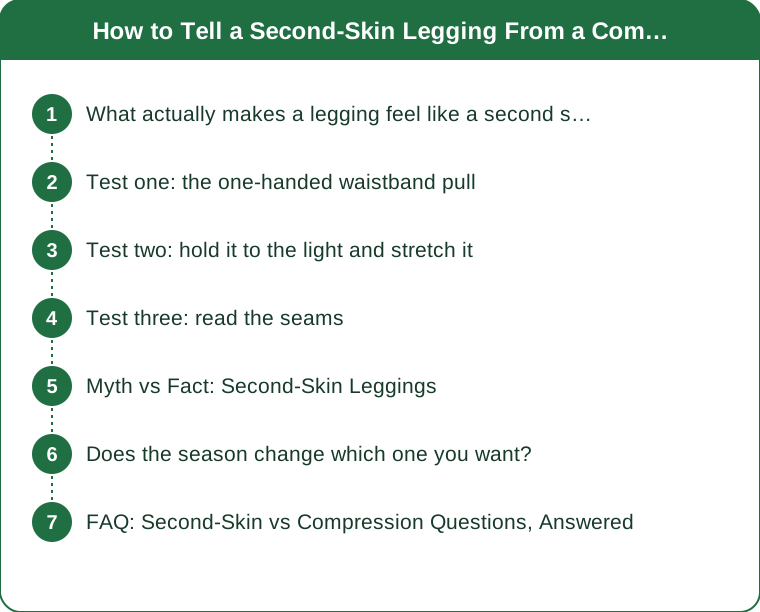
What actually makes a legging feel like a second skin?
A second-skin feel comes from low resistance to stretch, not from softness. Two fabrics can feel identical in the hand and behave completely differently once they are at 30 percent extension around a thigh.
The technical term is modulus - how much force it takes to stretch a fabric a given amount. Low modulus fabrics give easily and sit lightly. High modulus fabrics resist, and that resistance is what you feel as compression.
Elastane content is a clue but not the answer. A legging at 20 percent elastane can still feel firm if the knit is dense and the elastane is under high tension in construction.
Four-way stretch matters more than most people realise. A fabric that stretches generously side to side but poorly top to bottom will feel like a second skin standing and like a restraint in a deep squat.
Recovery is the other half. A fabric that stretches easily but returns slowly becomes a bagging legging by hour three, which is the opposite of a second skin.
And weight is deceptive. Some of the lightest fabrics on the rail are the firmest, because thin high-modulus knits are how brands get opacity without bulk.
Test one: the one-handed waistband pull
Hook two fingers into the waistband and pull outward with one hand only. You are measuring effort, not distance.
A second-skin waistband gives smoothly for the first few inches with very little build-up of resistance, then firms gradually.
A compression waistband resists almost immediately and the resistance climbs steeply. You can feel it in your forearm.
Do the same pull on the mid-thigh panel, which is often built differently from the waistband. Compression leggings frequently have a soft waistband and a firm leg, which is exactly how people get surprised at home.
Compare against something you already own rather than trying to judge in absolute terms. Bring the feeling of your favourite pair with you and use it as the reference.
Thirty seconds, both hands, two spots. This single test sorts the majority of the rail.
Test two: hold it to the light and stretch it
Unstretched opacity tells you almost nothing. Nearly everything looks opaque flat.
Stretch a section to roughly the width of your thigh and hold it up to a window. This is the state the fabric will actually be in when worn.
Second-skin knits usually lighten noticeably under stretch because the yarns are further apart in a lower-density knit. That does not automatically mean sheer - it means you need to check.
Compression knits change far less, because density is the point, and density is why they hold.
Check the back thigh and the seat specifically, which is where the fabric sees the most extension when you bend and where opacity failures actually happen.
A pair that stays fully opaque under real stretch and still pulls easily is the genuinely good one, and it is rarer than the marketing suggests.

Test three: read the seams
Flat-locked seams that curve around the leg signal a garment designed to move with the body and disappear - the second-skin approach.
Straight structural seams and contrast panels usually mean the panels are doing a job. That job is directing force, which is compression design.
Count the panels. Two to four is typical for a second-skin legging. Six or more with visible density changes points to targeted compression.
Look at the gusset. A generous diamond gusset supports free movement; its absence in a firm fabric is what produces the front-seam problem people complain about.
Check the hem finish. A soft raw-edge or coverstitched hem tends to accompany low-modulus fabric. A gripper band or heavy elastic at the ankle is a compression signature.
And check the waistband height and construction together. A thick multi-layer waistband on soft fabric is a smoothing design, which behaves differently again.
Myth vs Fact: Second-Skin Leggings
Myth: buttery soft means second skin. Fact: hand-feel is surface finish, which is a completely separate property from stretch resistance. A brushed high-modulus fabric feels wonderful in the shop and firm on the body.
Myth: more elastane means more compression. Fact: elastane provides stretch and recovery. Compression comes from knit density and how much tension the fabric is under at your size - a high-elastane fabric can be extremely soft.
Myth: if it is thin it will be sheer. Fact: yarn quality and knit density decide opacity. Some of the thinnest fabrics on the market are the most opaque because the knit is very tight.
Myth: sizing up gets you the second-skin feel. Fact: it reduces tension but also breaks the fit, so the legging shifts as you move - which is the single most reliable way to make a legging noticeable rather than invisible.
Myth: the two categories are interchangeable for the gym. Fact: they suit different work. Firmer fabric is often preferred for heavy lifting and long runs; low-modulus fabric suits yoga, mobility work and all-day wear.
Myth: you can tell from the product page. Fact: the vocabulary is not standardised across brands. The same phrase means different things at different labels, which is exactly why the three physical tests are worth doing.
Does the season change which one you want?
Yes, and more than people expect. Fabric behaves differently as temperature drops through late summer into autumn.
Cooler fabric is stiffer fabric. Elastane loses some of its give at lower temperatures, so a legging that felt like a second skin in July feels firmer on a 50F October morning - especially in the first ten minutes.
Which means a borderline-firm pair bought in summer can cross over into genuinely restrictive once the weather turns.
Warm up in them before you judge. Five minutes of movement changes the assessment substantially.
Autumn layering also changes the calculation, since a legging worn under a long top or a dress is judged on comfort rather than on hold.
And the practical takeaway: if you are buying now for autumn wear, err toward the softer, lower-resistance pair. The weather will add firmness for free.
FAQ: Second-Skin vs Compression Questions, Answered
Can one pair be both?
Sort of - some leggings use a soft low-modulus main fabric with a firm waistband or a single supportive panel. That is a hybrid, and it is worth knowing which part is doing what before you buy.
Which one should I buy for everyday wear?
Second skin, almost always. Firm fabric is fatiguing over eight hours in a way that is easy to underestimate in a two-minute fitting room trial.
Does compression help recovery?
Graduated medical compression garments are a specific product with specific pressures. General athletic compression leggings are not the same thing, and the evidence for performance and recovery benefits is mixed. This is general information, not medical advice.
Why did my second-skin leggings start feeling firm?
Usually washing. Heat and fabric softener both damage elastane over time, and a fabric with degraded elastane stretches less easily and recovers worse. Cold wash, no softener, air dry.
How do I test online?
You cannot fully, but you can read the fabric composition, look at the panel count in the product photos, and check whether the brand describes the pair as supportive or as soft - the language is usually honest even when it is not standardised.
Should the waistband leave a mark?
A light temporary mark after hours of wear is normal. A deep indentation, numbness or pins and needles is not - that is a fit or pressure problem worth addressing. This is general information, not medical advice.
TL;DR:
- Second skin means low stretch resistance and gentle recovery; compression means the fabric pushes back.
- Test one: pull the waistband and mid-thigh one-handed and feel how fast resistance builds.
- Test two: stretch the fabric to thigh width and hold it to the light - unstretched opacity is meaningless.
- Test three: flat curved seams and few panels signal second skin; straight structural panels signal compression.
- Softness is surface finish and tells you nothing about how the legging will feel worn.
- Cool weather stiffens elastane, so buy softer than you think for autumn.
Thirty seconds of pulling and squinting at a window saves you a pair you will not wear.
See It in Motion
Seen here: High Waist 8” Yoga Shorts — shop similar styles on bubblelime.com
Keep Reading
This article is for general informational and styling purposes only. Fit, sizing, and product availability may vary.