Why Two Leggings With the Same Stretch Percentage Feel Nothing Alike
Quick Answer: Stretch percentage tells you how far a fabric goes. It says nothing about how hard it pulls on the way or how well it comes back — and those two properties, called modulus and recovery, are what your body actually feels. Two fabrics can both stretch 60% and one can require twice the force to get there. The second-skin sensation comes from low pull with high return, which no label discloses.
This is why the composition tag is close to useless for predicting feel.
Here is what to read instead, and how to test it in about thirty seconds in a fitting room.

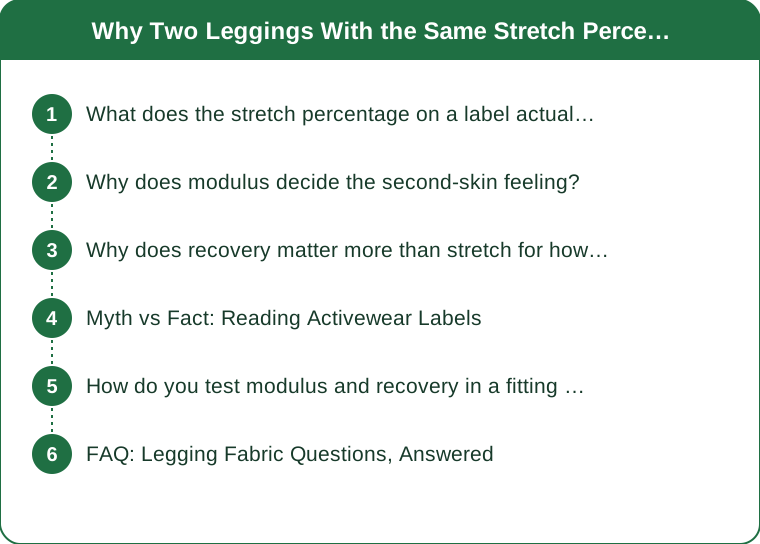
What does the stretch percentage on a label actually mean?
Less than almost everyone assumes.
The elastane figure — 15%, 20%, 22% — is a content figure. It tells you what proportion of the yarn blend is elastic fibre. It is a recipe, not a performance measurement.
What you feel when you wear a legging is decided by three separate properties, and the label discloses none of them directly:
Elongation — how far the fabric will stretch before it stops. This is the one people assume they are reading.
Modulus — how much force it takes to stretch it a given distance. A high-modulus fabric fights you. A low-modulus fabric yields easily and then holds.
Recovery — how completely it returns to its original dimensions after being stretched, and how fast.
Two fabrics with identical elastane content can differ enormously in modulus depending on how the yarn is knitted, how tightly, at what gauge, and how the elastane is wrapped or bare. A tightly knitted 18% fabric can pull harder than a loosely knitted 22% one.
So when you compare two leggings by their tags and conclude they should feel the same, you are comparing ingredients lists and expecting to predict the taste.
Why does modulus decide the second-skin feeling?
Because second-skin means forgettable, and forgettable means low continuous force.
Your skin has pressure receptors that adapt — they stop reporting a constant, gentle sensation after a while. That adaptation is the whole mechanism behind a garment disappearing on you. Something rests against you, nothing changes, and after a few minutes your nervous system stops mentioning it.
High-modulus fabric interrupts that. Every time you bend a knee or sit down, the fabric resists, the pressure spikes, and the receptors report again. You get a garment that reintroduces itself twenty times an hour.
This is also why compression leggings and second-skin leggings are genuinely different categories rather than different price points. Compression is meant to be felt — the sustained pressure is the product. Second skin is meant to vanish.
A useful way to think about it: second skin is a fabric that agrees with your movement, and compression is a fabric that has an opinion about it.
Both are legitimate. But if you bought one expecting the other, the composition tag is exactly what misled you.
Why does recovery matter more than stretch for how long it lasts?
Because a legging fails at the knees and seat long before the fabric wears through.
Every time you bend your knee, the fabric over the kneecap stretches. If recovery is good, it snaps back when you straighten. If recovery is mediocre, it comes back most of the way, and the shortfall accumulates across a day.
That is the mechanism behind the familiar pattern of a legging that fits beautifully in the morning and has soft baggy pouches at the knees by mid-afternoon. It is not stretching out permanently — a wash usually resets it. It is stretching faster than it recovers.
Recovery is largely a function of elastane quality and knit construction, not quantity. Higher-grade elastane fibres and a knit that lets the elastic yarn return without friction from the surrounding fibres both make an enormous difference, and neither appears anywhere on the packaging.
This is the single most reliable predictor of whether a legging still feels like a second skin in month six. Cheap leggings almost never fail on elongation. They fail on recovery.
And it is why a fabric that felt fractionally firmer in the shop frequently outperforms a softer one over a year — good recovery has a slight firmness to it that people mistake for a worse fit.

Myth vs Fact: Reading Activewear Labels
Myth: More elastane means stretchier and therefore more comfortable.
Fact: More elastane often means firmer. Higher elastane content with a dense knit is how compression fabrics are built. The comfort curve is not linear and it is not even monotonic.
Myth: The main fibre — nylon versus polyester — decides how it feels.
Fact: It decides more about moisture handling, softness of hand and durability than about fit sensation. Nylon feels smoother and softer; polyester dries faster and holds colour better. Neither one predicts second-skin feel by itself.
Myth: Buttery-soft fabrics are always the most comfortable to wear all day.
Fact: Surface softness and mechanical feel are independent. A very soft fabric with poor recovery is pleasant for ten minutes and saggy by lunch. Softness is what you notice in the shop; recovery is what you notice for the next year.
Myth: Thicker fabric means better quality.
Fact: Weight correlates loosely with opacity and durability and barely at all with feel. Some of the best-behaving fabrics are mid-weight; some of the worst are heavy.
Myth: Price reliably signals fabric quality.
Fact: Price correlates with fabric quality more weakly than almost any shopper expects, because a large share of the price of a legging is brand, marketing and retail margin rather than yarn. Testing beats trusting, every single time.
How do you test modulus and recovery in a fitting room?
Three tests, roughly thirty seconds total, and no equipment.
The pull test (modulus). Take a section of fabric between both hands, about 15cm apart, and stretch it to roughly double. Pay attention to the force, not the distance. A second-skin fabric yields early and easily then firms up towards the end of its range. A compressive fabric pushes back from the first centimetre.
The hold test (recovery). Stretch that same section to double and hold it for ten full seconds — most people release after two, which is not long enough to reveal anything. Let go and watch. Good recovery returns essentially to the original shape almost immediately. Mediocre recovery leaves a visibly slack area for several seconds.
The squat test (both together). Put them on, do three slow deep squats, and stand back up. Then look at the knees and the seat in the mirror. Bagging after three squats is a fabric that will bag after three hours.
One more that costs nothing: check the fabric at the back of the knee specifically. That is where the highest repeated strain lives and where recovery failure shows first.
And a seasonal note, since we are moving into the cooler half of the year — fabric modulus changes slightly with temperature, and most fabrics feel a little firmer in a cold shop and on cold legs than they will once you are warm. Test in the shop, but judge finally on a walk.
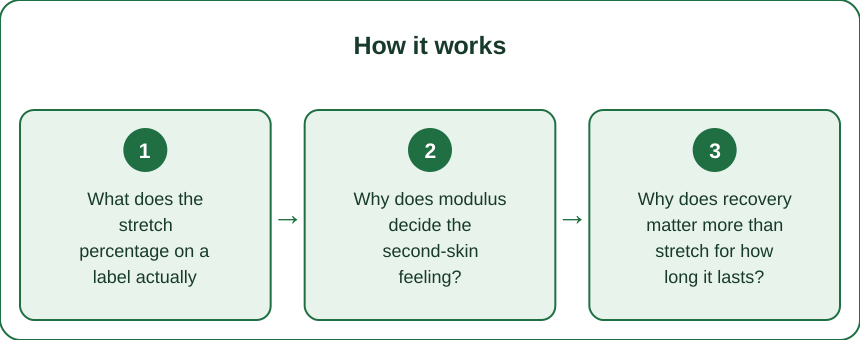
FAQ: Legging Fabric Questions, Answered
What elastane percentage should I actually look for?
Most well-behaved second-skin leggings land somewhere between 12% and 22%, which is a wide enough band to be nearly useless as a filter on its own. Use it to rule out extremes — under about 8% will not hold shape, over about 25% is usually deliberately compressive — and then test the fabric.
Does the second-skin feel come back after washing?
Usually, and quite noticeably. Most of what feels like a legging stretching out over a day is recoverable, and a cool wash with a proper rest to dry flat resets it. If it does not come back after washing, the recovery is genuinely gone and that is permanent.
Why does the same legging feel different on different days?
Mostly you, not the fabric. Body temperature, hydration, time since your last wash and even time of day change how a close-fitting garment reads. The fabric contributes too — it is fractionally firmer cold.
Is squat-proof the same as good recovery?
No. Squat-proof describes opacity under stretch — whether it goes sheer. A fabric can be perfectly opaque and recover badly, and vice versa. They are tested by two completely different motions.
Should I size up for a second-skin feel?
Generally no. Sizing up lowers the tension but the fabric then relies on the waistband to stay put, which usually produces sliding rather than comfort. Correct size in a low-modulus fabric beats a size up in a firm one, essentially always.
TL;DR:
- The elastane percentage is a recipe, not a performance figure — it predicts feel poorly
- What you actually feel is modulus (how hard it pulls) and recovery (how well it returns)
- Second skin means low pull with high return, so your skin adapts and forgets the garment
- Leggings almost never fail on stretch; they fail on recovery, which is what causes knee bagging
- Test with a ten-second hold and three slow squats before you buy, not with the label
Next time you are comparing two pairs, ignore the tags entirely and hold a stretched section for a slow count of ten. That one test tells you more about the next twelve months than every number printed on the packaging.
See It in Motion
Seen here: Super High Waist Embossed Yoga Leggings with Inner Pocket — shop it on bubblelime.com
Keep Reading
This article is for general informational and styling purposes only. Fit, sizing, and product availability may vary.