The Second-Skin Feel Has a Cost — and It Shows Up in Heat
Quick Answer: Second-skin feel comes from fine yarn, high knit density, and full-surface contact with your body. That same combination reduces airflow and holds a thin layer of warm, humid air against your skin. In cool conditions this is comfortable; in heat and humidity it is the reason a perfect-feeling pair becomes clammy. The fix is not looser fabric but targeted ventilation — mesh zones behind the knee and at the waistband, lighter gsm for summer pairs, and choosing nylon-dominant blends, which move moisture faster than polyester at the same density.
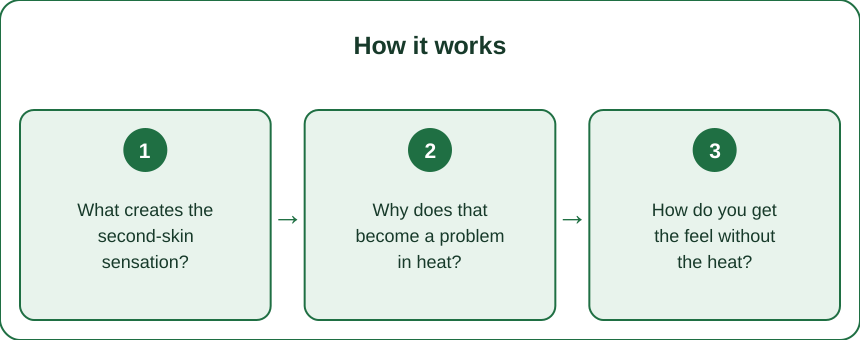
What creates the second-skin sensation?
Fine denier yarn. Thinner filaments bend more easily against skin, so the fabric conforms to your contours rather than sitting on top of them. This is the primary contributor.
High knit density. More stitches per inch means a smoother, more continuous surface with no perceptible texture. Your nervous system registers texture as sensation; a smooth surface registers as nearly nothing.
Consistent compression. A fabric with even pressure across the whole leg reads as part of you. Uneven pressure — a tight band here, a loose zone there — reads as a garment.
Four-way stretch with high recovery. The fabric moves with you and returns, so you never feel it resist. Resistance is what makes clothing noticeable.
Minimal or bonded seams. Every seam is a raised edge your skin can find.
Notice what all five have in common: they maximize contact and minimize gaps. That is the whole design goal, and it is genuinely well executed in good second-skin fabric.
It is also, precisely, the description of a fabric that does not let air through.
Why does that become a problem in heat?
Airflow needs gaps. A dense, fine-yarn knit has very small interstitial spaces, which is why it feels smooth and why air does not pass through it easily. Cooling by convection — air moving across skin — largely stops.
That leaves evaporation as the cooling mechanism, and evaporation needs the moisture to reach a surface where it can leave. A second-skin fabric wicks sweat away from skin effectively, but then has to move it through a dense structure to an outer surface. In humid air, the outer surface is already near saturation and the moisture has nowhere to go.
The result is the clammy stage: fabric saturated, skin damp, and no evaporative cooling happening. This is why the same pair can be excellent in dry heat and unpleasant in humidity.
Trapped air also insulates. The thin layer between skin and fabric warms to body temperature and stays there, which is a genuine benefit in a cool morning and a liability at 85 degrees.
And there is a compounding effect: saturated fabric becomes heavier and clings more, which increases contact area further and reduces the small amount of airflow that remained.
How do you get the feel without the heat?
Targeted ventilation rather than looser fabric overall. The good version of this is mesh or open-knit panels placed exactly where heat accumulates: behind the knee, at the back of the waistband, along the inner thigh, and at the lower back. These preserve the second-skin fit everywhere else.
Lower gsm for summer pairs. A 200 to 230 gsm fabric can still feel second-skin if the yarn and knit are good, while allowing meaningfully more airflow than a 280 gsm pair. Keep the heavier one for cool weather.
Nylon over polyester. Nylon absorbs a small amount of moisture into the fiber itself and moves it along the filament faster. At the same density, a nylon-dominant blend generally feels less clammy.
Flat-face over brushed. A brushed interior traps far more air and holds far more moisture. It is the right choice in autumn and the wrong one in August.
Lighter colors for outdoor heat, which reduce radiant heat gain — a separate mechanism from airflow but a real contributor outdoors.
Own two weights. This is the honest answer that most people arrive at. A summer pair and a cool-weather pair, both second-skin, both correct for their season. Trying to find one fabric that does both means accepting a compromise in each.
What Nobody Tells You About Second-Skin Fabrics
Fit tolerance is narrower. A fabric designed for full contact reveals every sizing error. Half a size too small produces visible tension lines; half a size too large produces the wrinkling that second-skin fabrics show more than looser ones.
They show contours, by design. That is not a defect — the whole point is minimal separation between fabric and body. If that is not what you want on a given day, it is a different pair, not a different size.
Recovery matters more here than anywhere. A second-skin fabric that loses recovery does not just sag; it stops making contact, and the entire sensation disappears. These pairs age noticeably rather than gradually.
They are the worst choice for layering under anything. No air gap means friction between layers and heat with nowhere to go.
Sweat marks show more, because the fabric is in full contact and saturates locally rather than distributing.
Sun protection is actually good. High knit density blocks UV well, so a dense second-skin legging is among the more sun-protective things you can wear on your legs — a rare case where density works in your favor.
FAQ: Second-Skin Fabric Questions, Answered
Does second-skin mean compressive?
Not necessarily. Second-skin describes the sensation of full contact; compression describes force applied. A soft, low-compression fabric can feel second-skin, and a firm compression fabric can feel like a garment.
Why do mine feel great for 20 minutes and bad after that?
That is the transition from dry to saturated. Once evaporation stops keeping up, the fabric changes character. It is a sign the pair is too dense for the conditions rather than a defect.
Are mesh panels worth the extra cost?
In summer, yes — a well-placed panel behind the knee makes a disproportionate difference. Poorly placed decorative mesh that does not sit over a heat zone is just a design element.
Should I size up for hot weather?
No. A too-large second-skin pair wrinkles and slides without adding meaningful airflow. Change fabric weight, not size.
TL;DR:
- Second-skin feel comes from fine yarn, high density, and full contact — the same properties that block airflow.
- In heat and humidity, evaporation stalls and the fabric turns clammy.
- Fix with targeted mesh panels (behind the knee, waistband, inner thigh), not with a looser fit.
- Choose 200 to 230 gsm and nylon-dominant for summer; save the heavy brushed pair for fall.
- Sizing up does not add airflow — change the fabric weight instead.
Second-skin is one of the best things activewear does. It just needs to be seasonal, the same way anything that works by trapping air does.
See It in Motion
Seen here: High Waist Yoga Leggings with Inner Pocket — shop it on bubblelime.com
Keep Reading
This article is for general informational and styling purposes only. Fit, sizing, and product availability may vary.