Why Sizing Down Ruins the Second-Skin Effect Instead of Creating It
Quick Answer: The second-skin effect is the absence of sensation — fabric moving exactly with you, pressing nowhere, gripping nowhere, never asking to be adjusted. That comes from a legging operating in the middle of its stretch range, where it can follow your body in every direction with force to spare. Sizing down pushes the fabric toward its stretch ceiling, where it stops following and starts resisting: the waistband digs and folds, the knees pull with every bend, the fabric thins toward sheerness, and you feel the garment constantly — the exact opposite of skin. Tight is a sensation. Second skin is the lack of one.
Here is the mechanics of why smaller feels worse, and how the right size actually behaves.
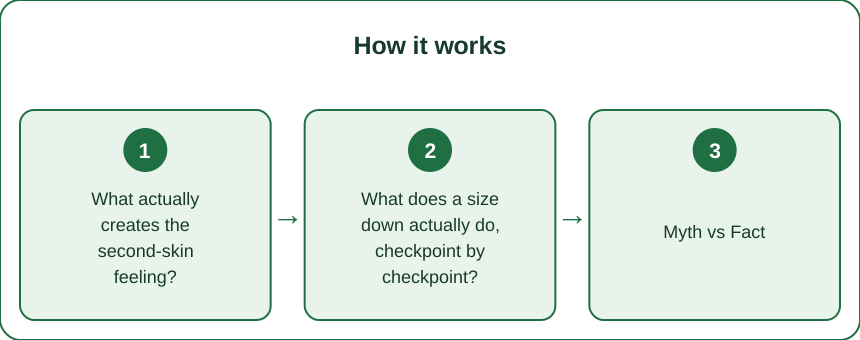
What actually creates the second-skin feeling?
Spare stretch — a legging living in the comfortable middle of its range, not the straining top of it.
Every stretch fabric has a working range: from relaxed, through the zone where it extends easily and recovers instantly, up to a ceiling where the fibers are near their limit and pull back hard. The second-skin sensation lives in that easy middle zone. When your size puts the fabric there, every movement you make — a squat, a stride, sitting cross-legged — asks the fabric for a little more stretch, and the fabric grants it instantly and silently, because it has plenty in reserve. Nothing tugs, nothing resists, nothing needs repositioning. Your brain, receiving no friction and no pressure signals, files the garment as body rather than clothing. That filing is the entire effect.
Size down and you relocate the fabric near its ceiling before you have even moved. Now every bend asks for stretch the fabric barely has, and it answers with resistance you feel at the knee, behind the hip, across the waistband. The garment becomes a constant low-grade negotiation — and a negotiation is precisely what skin never does.
The pressure story is the same. A legging in mid-range applies light, even contact everywhere — the gentle all-over touch that reads as smoothness. A legging at its ceiling applies real compression, and applies it unevenly: fiercest where the fabric is most stretched, at the waistband edge and the widest part of you, creating pressure lines your nervous system tracks all day.
Buttery-soft leggings make the trap especially seductive, because a brushed, forgiving fabric in a size down still feels pleasant standing in the fitting room. The fabric hand is soft; the fit is still wrong. Ten minutes of actual movement — not fitting-room standing — is where the difference reports in.
What does a size down actually do, checkpoint by checkpoint?
Four failures, in the order you will notice them.
The waistband digs, then folds. A waistband sized down sits under more tension than it was engineered for, so it presses a line into your waist — and the moment you sit, the tension resolves itself by flipping the band over. The all-day habit of hooking a thumb into your waistband to un-fold it is not a design flaw of the legging; it is the signature of a size. A correctly sized high-waisted band lies flat, presses evenly, and stays put through a full day of sitting precisely because it has tension to spare.
The fabric goes sheer where you need it most. Opacity is fabric density, and stretching fabric spreads its knit apart. A legging that is perfectly opaque on the hanger can fail the squat test purely because a size down parked it near maximum stretch across the seat. The same style, one size up, passes — which is why so many sheerness complaints in reviews are actually sizing stories. If you want yoga pants that stay confidently opaque in a deep squat, the single most effective spec is fabric that is not already at its limit standing still.
Everything migrates. Overstretched fabric pulls toward the path of least resistance: the rise slides down as you move, the knees bag outward from repeated max-stretch cycles, the hems creep up your ankle. Undersized leggings need constant hitching — and every hitch is the second-skin illusion breaking.
The garment ages on fast-forward. Fabric cycling near its stretch ceiling fatigues elastane quickly: the recovery slows, the knees stay bagged, the waistband relaxes into limpness within months. The size down is not just less comfortable — it is a shorter-lived purchase. A legging in its right size, cycling gently mid-range, keeps its snap for years of the identical treatment.
Myth vs Fact: Tightness and Fit
Myth: sizing down gives you more support and sculpt. Fact: deliberate compression is engineered — panels placed by design, pressure graded across zones. A size down just applies crude, uneven squeeze concentrated wherever you are widest. If you want genuine compressive support, buy a compressive style in your size; the engineering does what the smaller size only pretends to.
Myth: leggings stretch out, so buy small and let them give. Fact: quality leggings barely change through their life when washed cold and hung dry — what actually happens is the overstretched pair loses its recovery, which is damage, not adaptation. Buying small to break in is planning to wear a wrong size now so you can wear a worn-out one later.
Myth: if it slides down, it must be too big. Fact: undersized leggings slide constantly — a rise under maximum tension is actively pulling itself down every time your hip flexes. Too-big slides from lack of contact; too-small slides from too much tension. The tell: too-big wrinkles and gapes when standing still, too-small presses lines into your skin and folds its waistband when you sit. Most sliding complaints are the second kind.
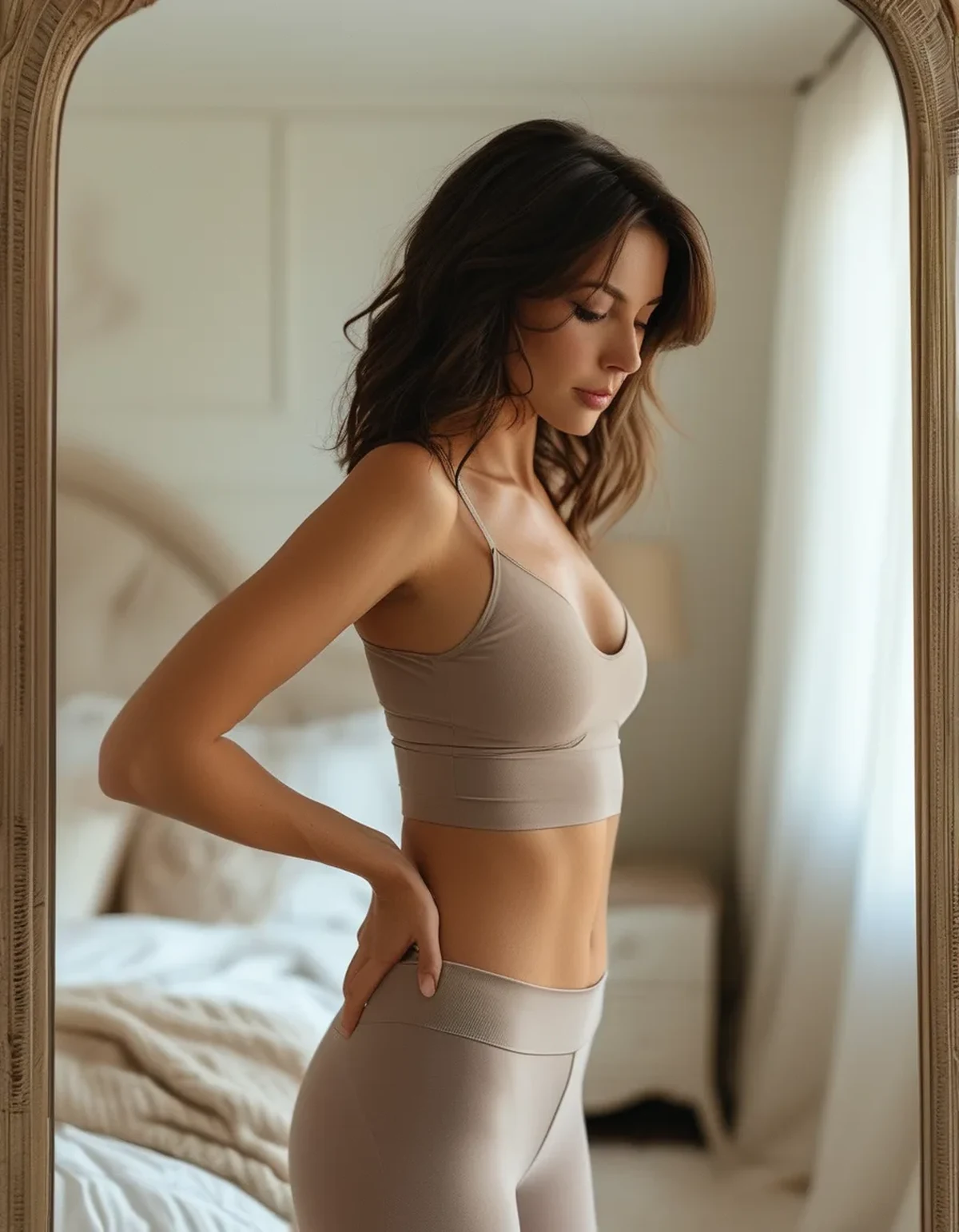
Myth: the second-skin look requires the second-skin squeeze. Fact: the sleek mirror silhouette comes from smooth, evenly tensioned fabric — which is the mid-range fit. The size down adds bulge lines at the waistband and sheened strain zones across the seat, both of which read clearly in photos. The right size is also the better-looking size, which is the least-advertised fact in activewear.
Myth: a gap between sizes means round down for athletic use. Fact: for high-movement use, round up — movement is exactly when fabric needs its reserve stretch. Round down only when a brand’s chart explicitly runs generous, which its reviews will say in unison.
How do you find the size that actually disappears?
A fitting protocol built around movement, because standing still is the one thing you will never do in them.
Start from the tape, not the label. Hip measurement against the brand’s chart, rounding up between sizes. Vanity sizing scatter across brands makes your usual letter a rumor, and the thirty-second measurement outperforms every guess.
In the fitting room, move immediately. Five deep squats, one lunge each side, thirty seconds of sitting cross-legged on the bench. Then the audit: Did the waistband stay flat and unfolded? Any pressure line at the band when you peel it back — a light mark is contact, a deep groove is a verdict. Did the knees pull as you bent? Did anything need hitching afterward?
Run the daylight squat test. Full squat facing away from the mirror in the best light available. Any hint of skin tone or underwear pattern through the seat means this size is running near its opacity limit — the same style one size up usually passes with room to spare.
Then apply the ten-minute rule at home. Wear the keepers for a full evening of actual living — cooking, sitting, stairs. The second-skin verdict is rendered by minute count, not mirror time: the pair you forget you are wearing has passed the only exam that matters; the pair you have adjusted twice before dinner has failed it, whatever the mirror said.
Recheck your size when the fabric family changes. Second-skin styles span brushed buttery-soft knits, dense compressive weaves, and seamless tubes — and each puts your body at a different point in its stretch range at the same nominal size. The number that disappears in one construction can be one off in another; carry the protocol, not the size, between brands.
The endpoint is worth naming plainly: the legging that feels like skin is the one delivering the least sensation per hour — and that pair is almost never the smaller of the two you were deciding between.
FAQ: Second-Skin Fit Questions, Answered
How snug should the waistband feel when I first put them on?
Like firm, even hand pressure — present all the way around, sharp nowhere. It should stay put through a squat without leaving a deep groove in your skin when you peel it back. A band you notice constantly is too tight; one that gapes when you bend forward is too loose.
My size feels perfect standing but digs when I sit. Which is right?
Sitting is right. You sit for hours and stand in mirrors for seconds — and sitting is when your waist and hips are at their widest. A legging must fit the seated version of you; the standing version will never complain about the extra ease.
Do second-skin leggings loosen as the day goes on?
Slightly — body heat relaxes elastane a touch, which is normal and recovers in the wash. If they go genuinely loose by afternoon, the elastane is fatigued — usually a dryer casualty or an old pair — and no starting size fixes tired fibers.
Is the fix ever actually sizing down?
Occasionally — if a fresh pair in your measured size wrinkles behind the knees, gapes at the waistband standing still, and never presses anywhere, the brand runs generous and the smaller size is your true size. The protocol stays the same: the right size is the one that vanishes in motion, whichever direction the chart missed.
TL;DR:
- Second skin is the absence of sensation, produced by fabric in the middle of its stretch range with reserve to follow every movement silently.
- Sizing down parks fabric at its ceiling: digging, folding waistbands, sheer seats, constant migration, and elastane that ages on fast-forward.
- Real support comes from engineered compression in your size, not crude squeeze from a smaller one — and the right size photographs better too.
- Find it by tape measure plus movement: squats and sitting in the fitting room, the daylight sheerness check, and the ten-minute forget-test at home.
Next fitting room, take both candidate sizes in and do five squats in each. Buy the one you felt less — the whole second-skin promise is hiding in that comparison.
See It in Motion
Seen here: Super High Waist Embossed Yoga Leggings with Inner Pocket — shop it on bubblelime.com
Keep Reading
This article is for general informational and styling purposes only. Fit, sizing, and product availability may vary.